A Lakha Red quote is not enough to approve a project: the stone can vary between blocks, and the quoted rate may hide slab yield, repairs, fabrication, transport, or matching requirements. By the end, you will be able to compare red granites, select suitable applications and finishes, inspect full slabs, calculate a realistic order, and define the supplier’s delivery and fabrication responsibilities.
Key takeaways
- Compare the actual slab, not only the granite name.
- Choose another surface for high-stain or highly uniform design requirements.
- Inspect slab colour, veining, cracks, edges, and finish before approval.
- Confirm measurements, matching requirements, wastage, and quotation terms in writing.
How Lakha Red Compares with Other Red Granite in Pune
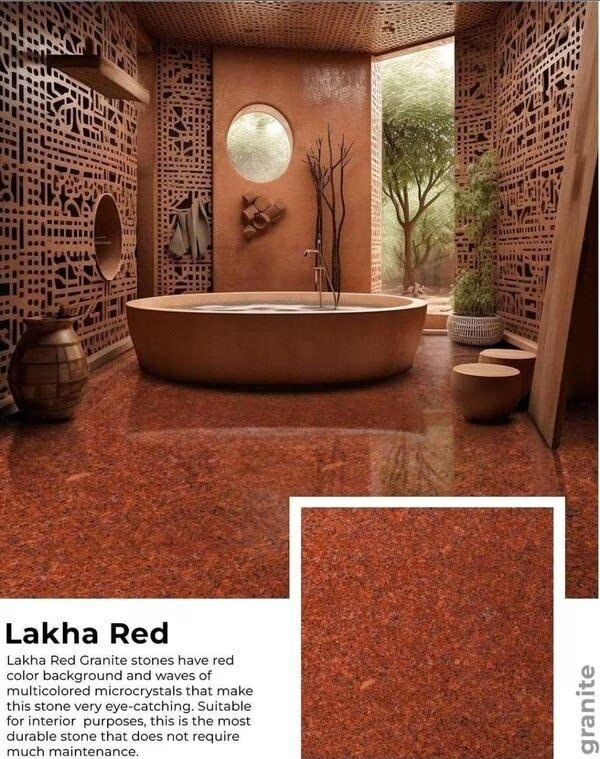
Lakha Red is usually a warm red granite with black and grey mineral distribution, while Red Pearl tends toward a darker, more granular appearance and Multi Red shows stronger mixed red, black, grey, and sometimes pale patterning. Names are not uniform grades, so inspect the actual slab rather than comparing colour labels.
| Option | Typical visual character | Comparison point |
|---|---|---|
| Lakha Red | Red background with black and grey mineral movement | Ask whether slabs come from one lot and approve the pattern |
| Red Pearl | Darker red field with dense, pearl-like mineral texture | Compare background depth and grain scale |
| Multi Red | More visibly mixed red, black, grey, and pale minerals | Compare variation, matching difficulty, and usable yield |
| Other red granite | Appearance varies by quarry and processing source | Confirm the quarry or processing origin |
Before comparing prices, ask a lakha red granite dealer in pune for these exact details:
- Slab thickness and nominal length and width
- Finish, such as polished, leathered, or flamed
- Quarry or processing origin, lot number, and bundle identification
- Resin treatment, mesh backing, fissure filling, or repaired areas
- Price basis: gross slab area, usable slab area, or fabricated installed area
- Allowance for cut-outs, edge returns, breakage, fissures, and colour matching
ASTM C615/C615M addresses granite dimension stone, not uniformity of a commercial colour name. Request project-suitable absorption, strength, and abrasion data separately, then approve a full slab—not a 100–300 mm sample—before ordering.
Where Lakha Red Works—and Where Another Surface Is Better
Lakha Red suits kitchen counters, stair treads, vanity tops, table tops, reception counters, interior floors, and feature walls where its red background and black-grey mineral pattern are part of the design.
It is natural granite, so fissures, pits, mineral movement, resin fills, and repaired zones can occur; approve the actual slabs rather than demand artificial uniformity.
For interiors, choose polished for colour depth and easy wiping, or honed for less reflected light. Outdoors, use flamed or bush-hammered surfaces for better slip resistance; polished stone can become slippery when wet and lose its sheen under weather exposure.
- Choose it for bold residential or commercial surfaces where variation is acceptable.
- Avoid it for large areas needing a consistent pale colour, minimal pattern, or concealed joints.
- Do not use a polished finish at wet, exposed entrances without checking slip performance and drainage.
- Ask for the quarry or processing origin when you buy Lakha Red granite in Pune; the trade name does not guarantee one quarry block.
| Option | What it offers | Choose it when |
|---|---|---|
| Lakha Red | Red-black natural variation | You want a strong, warm statement surface |
| Quartz | Consistent colour and low routine sealing | Indoor counters need visual uniformity |
| Porcelain | Low water absorption and durable finish options | Outdoor paving or wet exposure demands easier maintenance |
| Marble | Veining and a softer, more refined appearance | You accept etching, staining, and regular care |
| Different red granite | Another pattern, grain, or finish response | Lakha Red’s mineral distribution does not suit the elevation or layout |
Check slip data and maintenance instructions before approving any exterior installation.
How to Inspect Lakha Red Granite Slabs Before Approval
A 100–300 mm sample cannot show the colour spread, fissures, resin patches, or edge damage across a full slab. At a Lakha Red granite showroom, inspect the actual slab or bundle selected for your project, not only a polished display piece.
1. Examine the face under bright, oblique raking light and, where possible, backlighting. Check whether the red background is consistent with the approved sample, then mark open fissures, pits, black and grey mineral clusters, cloudy zones, resin-filled areas, and visible repairs. A polished surface can hide defects that become obvious after cutting.
2. Run your hand and a straightedge along every edge. Look for chips, hairline cracks, uneven thickness, resin at broken corners, and edges that are not square. Damage near a sink cut-out, stair nosing, or long countertop joint can reduce the usable slab.
3. Turn the slab over and inspect the underside. Confirm whether mesh backing covers the entire area, whether it is lifting, and whether resin or cement repairs conceal cracks. Tap suspicious zones lightly and compare their sound with sound stone; record any hollow response for the fabricator.
4. Measure thickness at several points and compare the result with the purchase specification. Confirm the lot or bundle number, nominal dimensions, quarry or processing origin, and whether the displayed slab is the one scheduled for delivery.
5. Approve the finish only after viewing that same finish on a full slab. Polished Lakha Red usually appears darker and more contrast-rich than honed, leathered, or flamed stone; those finishes also change cleaning and maintenance requirements. Get every accepted defect and repair noted on the order.
How to Match, Measure, and Price the Required Slabs
1. Freeze the layout before requesting a quote. Mark slab positions for each counter, floor zone, stair tread, or wall panel, then sequence adjoining pieces so the red background, black-grey mineral pattern, and veins flow consistently. Reserve matching slabs for book-matched panels, waterfall edges, and long uninterrupted runs.
2. Separate net installed area from purchasing area. Measure each finished piece, including stair risers, wall returns, upstands, backsplashes, edge drops, and overhangs. Add allowances for sink and hob cut-outs, unusable fissures, edge damage, breakage, and colour matching; slab yield can fall well below the simple countertop area divided by slab area.
3. Specify the material precisely: nominal slab length and width, 18–20 mm or another approved thickness, finish, lot or bundle number, and whether it is resin-treated, mesh-backed, or repaired. Choose thickness from span, overhang, loading, substrate, and support—not from the colour catalogue. Heavy stair treads and cantilevered counters need engineered support.
4. Get fabrication priced separately from stone. List cutting, profiling, polishing, visible edge returns, mitred waterfall joints, sink and hob cut-outs, tap holes, transport, hoisting, installation, adhesive, sealing, and removal of waste. Ask for shop drawings showing joints and vein direction before cutting.
5. Compare quotations on one basis. A price for Lakha Red granite slabs in Pune may mean gross slab area, usable slab area, or fabricated installed area; these figures are not interchangeable. The real installed cost is material plus wastage, fabrication, logistics, fixing, support, and taxes.
Ask the supplier to state every component and the final payable amount.
What to Require from a Lakha Red Supplier in Pune
Obtain a written quotation tied to the exact slabs you inspected, not merely to the name Lakha Red. A Lakha Red granite supplier in Pune should identify the quarry or processing origin, slab thickness, nominal dimensions, finish, lot or bundle number, and whether each slab is resin-filled, mesh-backed, repaired, or untreated.
Ask for these records before paying an advance:
- Slab-wise photographs or inspection access for the selected lot, including faces, edges, undersides, and cut-out areas.
- A packing list showing slab numbers, dimensions, thickness, bundle identification, and total gross area.
- Test results stating the method and values for water absorption, apparent density, compressive strength, flexural strength, and abrasion resistance, with the report linked to the lot.
- Confirmation of the applicable granite-slab standard, such as IS 14223, where the supplier claims compliance.
- The quarry or processing location and a written statement that substitutions require your approval.
| Quotation basis | What it means | Why it matters |
|---|---|---|
| Gross slab area | You pay for full purchased slabs | Offcuts, fissures, and matching reduce usable yield |
| Usable slab area | The supplier defines acceptable area | Require the acceptance definition in writing |
| Fabricated installed area | Cutting, edges, and fitting enter the price | Confirm whether transport, sink cut-outs, sealing, and installation are included |
Before dispatch, agree who pays for breakage, unloading, inspection, rejected slabs, and replacement. Specify an A-frame, padded packing, covered transport, delivery date, storage location, and responsibility until signed acceptance. RK GRANITE should record these terms on the order rather than leaving them to a phone conversation.
Related product
 | Granite RK Granite presents premium Lakha Red Granite in Pune, known for its vibrant red base with subtle black and grey veins, adding a bold and elegant... View product → |
Frequently asked questions
How does Lakha Red compare with Red Pearl and Multi Red granite?
Lakha Red is usually warm red with black and grey mineral distribution. Red Pearl tends to look darker and more granular, while Multi Red has stronger mixed red, black, grey, and sometimes pale patterning. Names are not uniform grades, so compare the actual slabs.
Where does Lakha Red granite work best?
Lakha Red suits projects that need a warm, patterned natural-stone surface for applications such as counters, stairs, flooring, or feature areas, provided the slab’s finish and performance meet the use.
When is another surface better than Lakha Red?
Choose another surface when you need highly uniform colour, a different maintenance profile, or performance better suited to the specific exposure, staining risk, dimensions, or design requirement.
What should you inspect before approving Lakha Red slabs?
Inspect the full slab for colour consistency, mineral distribution, cracks, pits, repaired areas, edge damage, thickness, finish quality, and whether adjoining slabs create an acceptable match.
How should you calculate Lakha Red granite slab requirements?
Measure each finished area separately, include cut-outs and edge details, plan the layout before ordering, and confirm the supplier’s allowance for cutting and wastage in the quotation.
Keywords