A quoted slab size is not the same as the usable stone you receive after trimming, defect removal, cut-outs and pattern matching. By the end, you will be able to compare Pune slab quotations, estimate usable quantity, choose thickness for each application and place joints where the directional pattern looks intentional.
Key takeaways
- Treat 8 × 4 ft and 9 × 5 ft as nominal slab sizes.
- Record clear slab dimensions in millimetres after inspection.
- Calculate usable area after deducting defects, cuts, joints and edge losses.
- Approve streak direction, joints, thickness and maximum piece size before ordering.
What slab sizes and thicknesses can you actually buy in Pune?
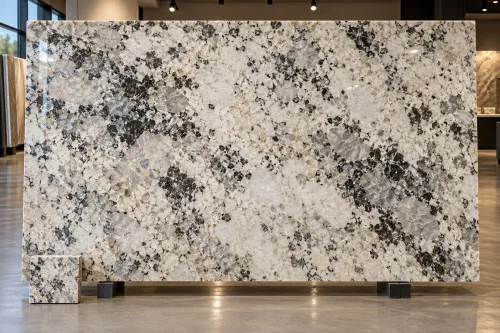
Tiger Skin granite slab sizes in Pune are commonly quoted as nominal 8 × 4 ft or 9 × 5 ft, not guaranteed usable areas. Record every dimension in millimetres and ask for the minimum clear length and width after inspection.
| Format | Nominal size or thickness | Approximate gross coverage | What the quotation means |
|---|---|---|---|
| Full slab | 8 × 4 ft | 32 sq ft | Untrimmed trading size; yield falls after edge damage, resin repair and defect removal |
| Full slab | 9 × 5 ft | 45 sq ft | Larger trading format; confirm the processor’s measured dimensions |
| Slab thickness | 16–20 mm | Not applicable | Common for walls, counters and floors; verify actual calibrated thickness |
| Slab thickness | Approximately 30 mm | Not applicable | Heavier and thicker; confirm stock, tolerance and calibration status |
| Fabricated piece | Cut-to-size, remnant, backsplash strip, stair tread or tile | Piece-specific | Not a full slab; record each piece’s clear dimensions |
Tiger Skin granite sizes for projects in Pune should also state finish, lot number, actual measured thickness, permitted tolerance and whether measurement is before or after calibration. A 2.4 × 1.2 m slab can lose usable area through trimming, chipped-edge removal, resin repair or natural-defect removal.
“Granite piece” is insufficient: request the item type, cut plan and clear dimensions before comparing a full slab with a counter component, backsplash, stair tread or tile.
How do you calculate usable quantity instead of buying by gross area?
A 10 × 2 ft counter covers 20 square feet, but you cannot order 20 square feet of Tiger Skin Granite and expect it to fit. Usable quantity depends on the finished dimensions, the actual slab map, defects, cut-outs and the direction of the pattern.
1. Measure each finished length and width, including wall panels, counters, islands, backsplashes and flooring modules. Convert the result to square feet or square metres, and record openings separately.
2. Place those dimensions on the actual slab in a nesting diagram. The drawing must show every piece, grain direction, seams, sink and hob cut-outs, tap holes, backsplash pieces, edge build-ups and pattern-matching requirements.
3. Subtract areas blocked by open defects, chipped edges, resin repairs or unusable natural fissures. Then add stone needed for trimming, cut-outs, tap holes, returns and matching adjacent pieces; a cut-out does not automatically become usable stock.
4. Agree on separate allowances for a straight wall, L-shaped counter, island, large wall panels, diagonal flooring and book-matched layouts. A rectangular wall can nest efficiently, while angled corners, large cut-outs and mirrored patterns leave narrow offcuts.
5. Recheck the yield after the fabricator marks the slab. Remnants, backsplash strips and stair treads have limited dimensions and cannot be counted as full-slab coverage; flooring pieces also need replacement stock if a later break occurs.
For Tiger Skin granite sizes for projects in Pune, request the nesting plan before releasing the slab. A practical Tiger Skin granite selection guide should treat yield, not gross area, as the approval figure.
Which thickness and maximum piece size suits walls, counters, vanities and floors?
A 16–20 mm slab suits many walls, vanity tops and supported counters; choose approximately 30 mm where added stiffness, edge mass or heavier use justifies it. Neither thickness gives a universal maximum piece size.
| Application | Suitable thickness and format | Main limits |
|---|---|---|
| Wall cladding | 16–20 mm panels or cut-to-size pieces | Weight, lifting route, stairs, door openings, hoist and mechanical fixing |
| Counter or island | 20 mm with bonded edge build-up, or approximately 30 mm | Sink, hob, tap and backsplash cut-outs; support at dishwashers and overhangs |
| Vanity top | 16–20 mm with continuous cabinet support | Basin cut-out, tap holes and unsupported corners |
| Stair tread | Confirm the actual stocked thickness before specifying | Tread span, nosing, support and joint position |
| Flooring | Large slabs or smaller cut-to-size modules | Handling, replacement, waste and required joint layout |
A double edge does not make unsupported 20 mm stone structurally equal to 30 mm stone. For Tiger Skin granite for counters in Pune, have the fabricator approve the support detail around sinks, dishwashers, peninsulas and overhangs before cutting.
On a Pune wall, the drawing cannot decide panel size alone. Confirm panel weight, lifting equipment, staircase clearance, door openings, hoist access, joint width and the mechanical fixing system; joints become necessary when safe handling or fixing exceeds the available panel size.
For Tiger Skin granite for flooring in Pune, large pieces reduce grout joints but increase handling, replacement difficulty and waste. Smaller modules can yield better around defects and directional movement. Ask for the actual stock thickness, slab map and approved support plan: there is no universal maximum dimension.
How should you place joints when the streak pattern runs across a surface?
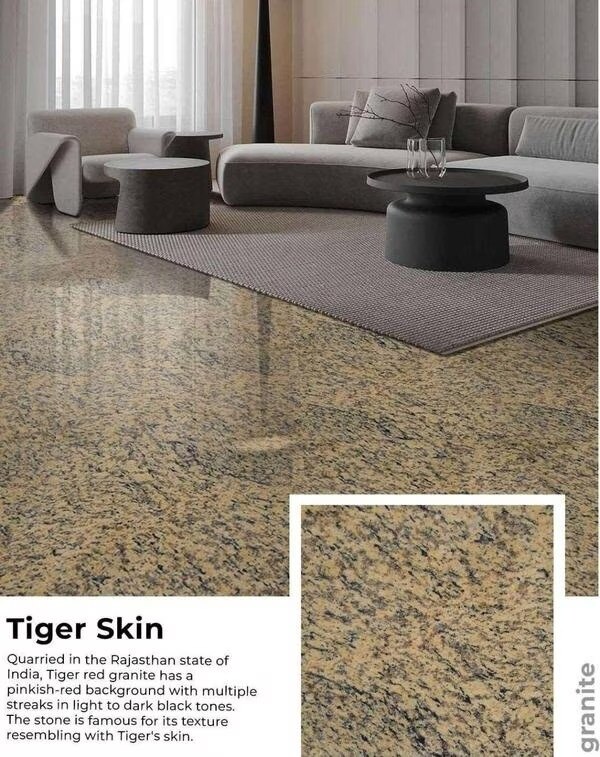
A seam should follow the streak pattern, not simply the shortest cut. Inspect several actual slabs spread out together; a catalogue image or small showroom sample cannot show slab-to-slab changes in black, brown, gold and grey movement, open grain or resin-filled fissures.
1. Check each slab dry and wet under the project lighting. Wetting can darken bands and expose fissures, while honed, leathered, flamed or textured finishes alter colour and contrast. A polished finish is not automatically suitable for a bathroom, entrance or wet kitchen floor; assess slip resistance for the intended exposure.
2. Make a dry layout from the actual slab map before cutting. Keep the streak direction consistent across a counter, backsplash or wall panel where continuity matters. Rotating a slab can create an abrupt band, a concentrated dark patch or reversed movement, while matching direction can consume more material.
3. Mark seams away from sink, hob and tap cut-outs, where narrow strips and weak-looking interruptions are more visible. Place them at natural pattern breaks or align them with cabinet divisions.
4. Review the layout at standing eye level under the installed lights. For tiger skin granite for counters in Pune, inspect how the cut-outs remove the strongest pattern. For tiger skin granite for flooring in Pune, compare whether smaller modules reduce waste and make replacement easier than large slabs.
Approve the dry layout before fabrication; a later seam cannot correct mismatched direction.
What should a Pune quotation and approval checklist contain?
Approve a specific lot, not the appearance name. “Tiger Skin” is a commercial appearance label, not a universally controlled petrographic grade; your Tiger Skin granite selection guide should therefore identify the actual stone being delivered.
1. Record the quarry or source, lot number, approved slab photographs, finish, measured length and width in millimetres, nominal thickness, delivered thickness, minimum clear length and width, edge condition, and calibration status.
2. State whether the quotation covers a full slab, cut-to-size pieces, polishing, edge profiles, cut-outs, backsplash strips, or stair treads. Include transport, lifting and handling, installation responsibility, and the written allowance for breakage and unusable offcuts.
3. Request the actual slab map, nesting plan and joint drawing. These documents show whether the quoted Tiger Skin granite slab sizes in Pune will cover your counter, wall or floor after trimming, defect removal and pattern alignment.
4. For technical comparison, ask which results relate to ASTM C615/C615M, ASTM C97/C97M for absorption and bulk specific gravity, and ASTM C170/C170M for compressive strength. Test data does not replace inspection of the approved slabs, finish, fissures, resin repairs and fabrication risks.
RK GRANITE can help by providing exact in-stock slab photographs, measured dimensions and lot details before you approve a counter, wall or floor order. Reject any quotation that identifies only “Tiger Skin granite” without these records.
Related product
 | Granite RK Granite offers premium Tiger Skin Granite in Pune, a unique natural stone famous for its golden-yellow base with striking black and brown streaks... View product → |
Frequently asked questions
What tiger skin granite slab sizes can you buy in Pune?
Pune suppliers commonly quote nominal slabs of 8 × 4 ft or 9 × 5 ft. Ask for each slab’s minimum clear length and width after inspection, then record those measurements in millimetres.
How do you calculate usable tiger skin granite quantity?
Start with the inspected clear slab area, then deduct unusable defects, cut-outs, edge trimming, joints and pieces that cannot be reused. Compare the resulting usable area with your cutting layout instead of ordering only by room area.
Which tiger skin granite thickness suits walls, counters, vanities and floors?
Choose thickness after checking the application, support, span, cut-outs, edge profile and handling limits. For counters, vanities and floors, confirm the fabricator’s permitted maximum piece size and support details before approval; walls also require a fixing system suited to the slab weight.
How should you place joints when tiger skin granite has streaks?
Mark the streak direction on the cutting plan before fabrication. Place joints where the pattern changes least, align adjacent pieces deliberately, and approve a dry layout or slab photographs before cutting.
What should a Pune tiger skin granite quotation include?
Require the slab’s nominal and clear dimensions, thickness, finish, grade, quantity, wastage basis, cut-outs, edge profiles, joint plan, transport, installation, taxes, delivery date and approval process for colour and streak variation.
Keywords